News
Recent Museum Acquisitions
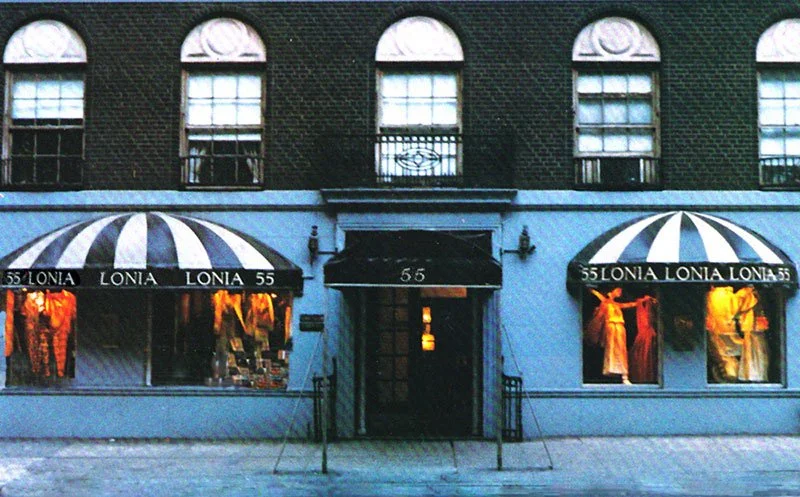
In 2026 The Fashion Institute of Technology (FIT) acquired the archive of Linda Friedman Schmidt’s legendary New York City store LONIA located at 55 West 55th Street from 1973-1987. LONIA was Linda’s first artwork, a work in progress for 14 years, an ongoing, long-running solo show, a showcase for her creativity and talent for visual merchandising.
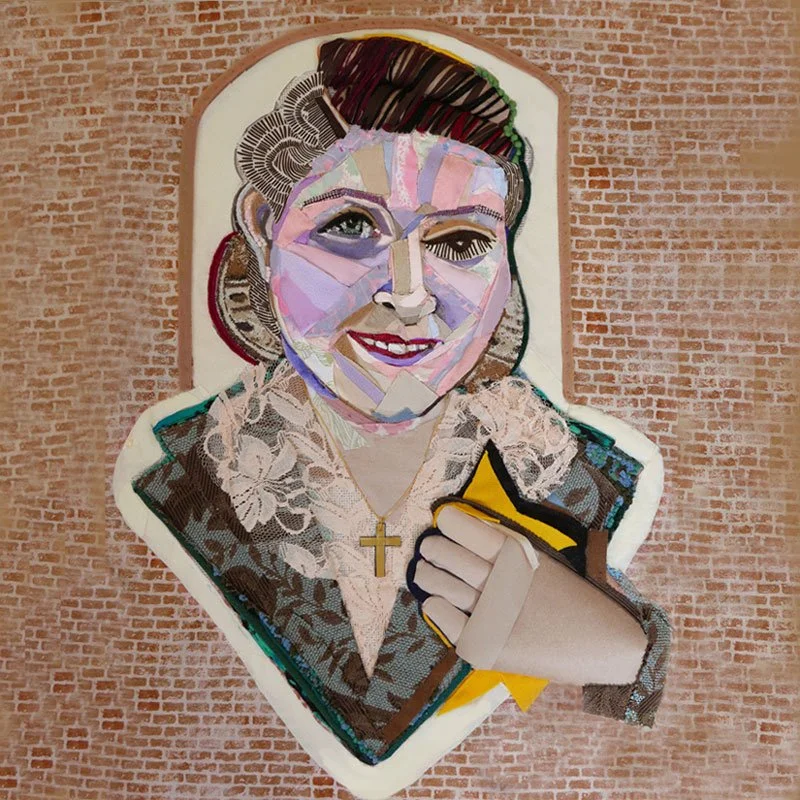
In 2025 Linda’s artwork She Resisted was acquired for the permanent collection of the Ghetto Fighters’ House Museum in Galilee, Israel. This is the perfect venue for artist Linda Friedman Schmidt’s commemorative portrait of her Aunt Toby, a resistance fighter who smuggled guns and ammunition into the Warsaw Ghetto while working as a seamstress sewing Nazi uniforms.
2025 Awards
Artist Linda Friedman Schmidt is honored to be a recipient of a 2025 artist grant awarded through the New Jersey State Council on the Arts Individual Artist Fellowship program. This competitive cash award administered by Mid Atlantic Arts is granted solely on independent peer panel assessment of work samples. The anonymous process is focused on artistic quality.
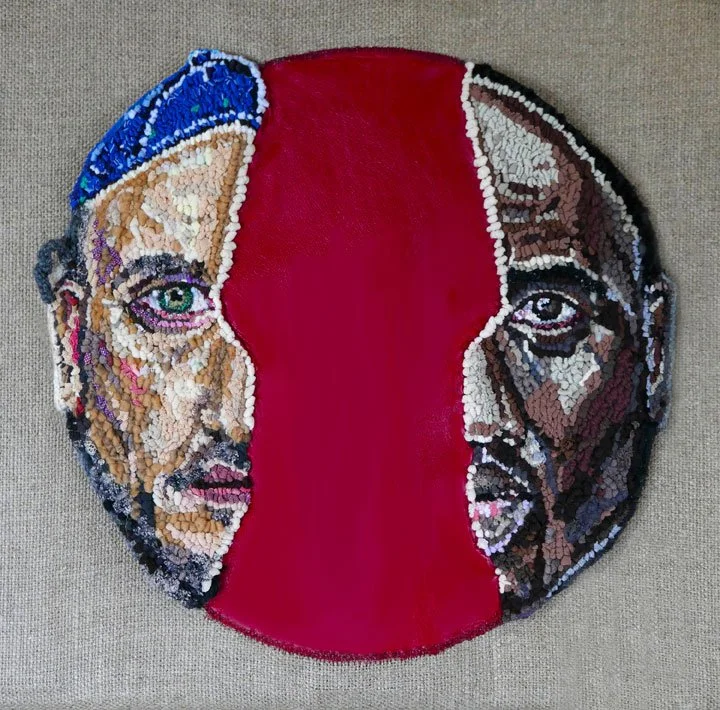
Linda’s artwork Fault Line was a winner of the Juror Award for ”The Bias Inside Us” 2025 exhibition at The Monmouth Museum, a collaboration with the Smithsonian Institution.
Artist Audio Recording
2023 Cornell University audio recording with video features Artist Linda Friedman Schmidt explaining the motivation behind her artwork during the “Threading the Needle” exhibition.
Interviews
2025 The Untitled Magazine Print Art Edition 001 “The Art of Resistance”An exclusive interview with artist Linda Friedman Schmidt by Editor-in-Chief and Creative Director Indira Cesarine is published in this issue. Available to order at untitled-magazine.shop
Interlocutor Magazine May 20, 2021 An in-depth interview with Artist Linda Friedman Schmidt by Millicent Borges Accardi begins with questions about her four artworks in the exhibition “UNRAVELED: Confronting the Fabric of Fiber Art” and continues with queries about the purpose of her art, her childhood, her process, medium, technique, and more.
Press and Film
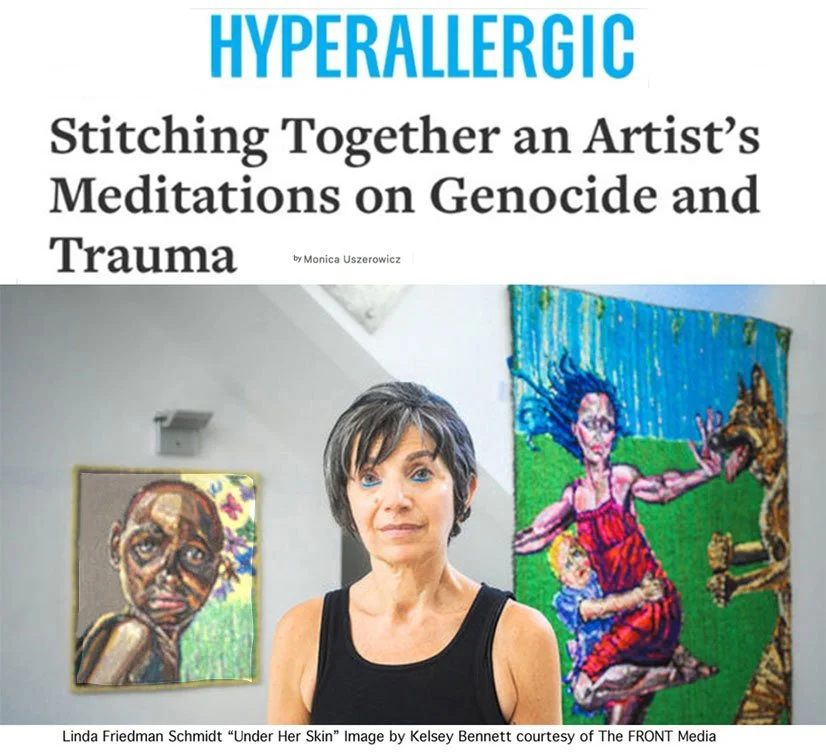
A film about artist Linda Friedman Schmidt released on Hyperallergic!
Under Her Skin: Linda Friedman Schmidt, a short documentary about the artist was released on the highly regarded online arts magazine Hyperallergic. The film is directed by Kelsey and Rémy Bennett and produced by The FRONT Media.
Artist Linda Friedman Schmidt’s “Weeding” on German Magazine Cover
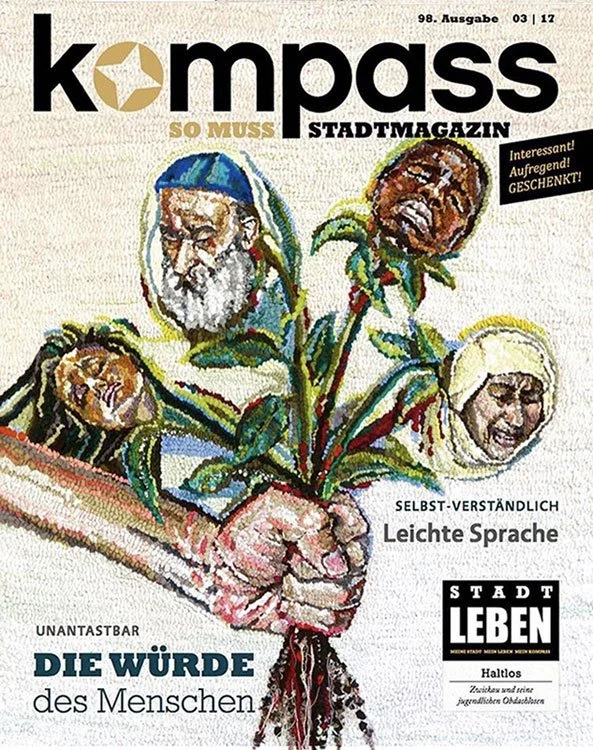
Linda Friedman Schmidt’s activist art was featured on the cover of the German Magazine Kompass.
“Weeding,” discarded clothing, 26 x 26 inches confronts not only Germany’s dark past, but also its present radical right wing anti-immigrant, anti-muslim, and anti-Roma views.